
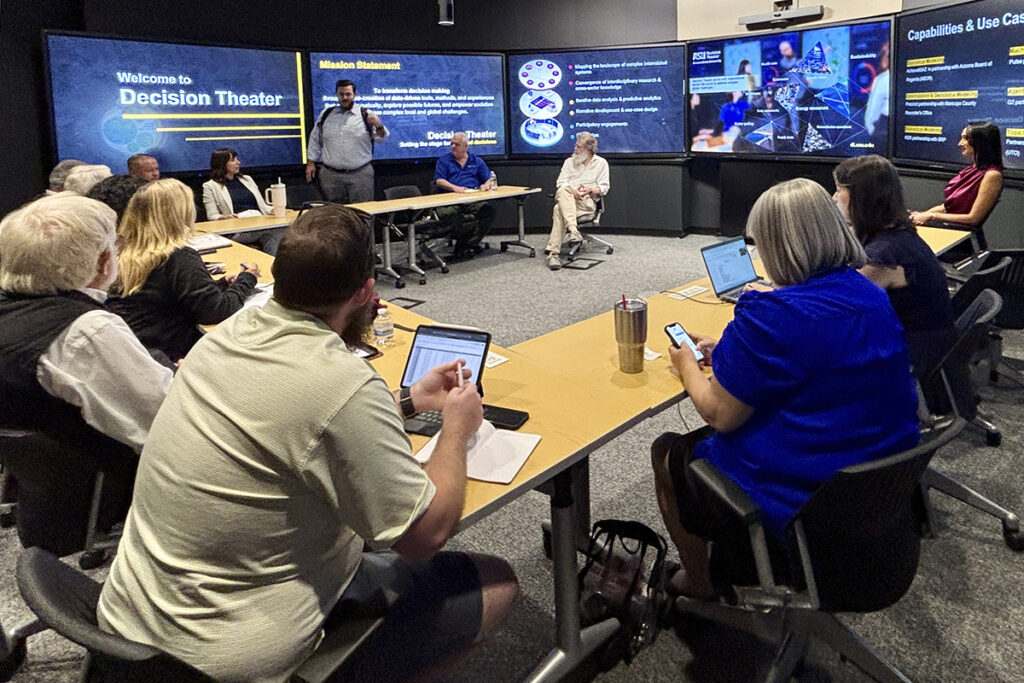
Surrounded by interactive, live data visualizations, a hodgepodge of government and community leaders sat in a semicircle yesterday to brainstorm possible solutions to the issues affecting Pinal County’s roads.
The session at Arizona State University’s Decision Theater was in stark contrast to the sterile government institutions that usually host such conversations. It was exactly the type of environment State Rep. Teresa Martinez (R-Casa Grande) looked for to address one of her biggest headaches: transportation infrastructure in her district, which includes Maricopa.
“I’ve been frustrated with [the Arizona Department of Transportation] and them dragging their feet and just relying on their engineers,” she said, speaking of several projects delayed recently by the state’s transportation authority.
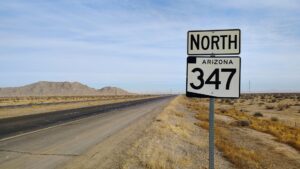
This includes State Route 347.
“My biggest frustration [with SR 347] is we don’t have an immediate, short-term solution to relieve traffic a little bit for the people,” Martinez said. “ADOT adjusted the lights and that’s hit-and-miss sometimes. But there’s nothing else, it seems.”
Thinking outside the box
That’s where ASU’s Decision Theater, at its flagship campus in Tempe, steps in.
Martinez said the university invited her to help find solutions to the county’s well-documented infrastructure problems, including those of traffic and safety.
It’s a relationship Martinez said she hopes can generate new ideas for solving issues related to SR 347 and Interstate 10.
She first learned about the Decision Theater when working as a staffer for U.S. Rep. Paul Gosar (R-Ariz.).
“Years ago, I came here with Congressman Gosar, and they wanted to show him a model of water because he’s on the House Natural Resources Committee,” she said. “They did a presentation on water, then moved over to another on elections. The way they were able to show off all that data — I was blown away by it.”

“It is basically a facility that is designed to make knowledge and data available for informed decision making about the challenges that we need to face moving into the future,” he said.
This means bringing together researchers, policymakers and community stakeholders with an impressive showcase that uses layer upon layer of interactive visual data, maps and simulations. Past projects have included interactive data on city disaster responses and evaluating Arizona’s educational future and workforce.
‘Ground zero’ for traffic solutions
Her initial experience with the theater prompted Martinez to turn to the nation’s largest university to alleviate her SR 347 headache.
Decision Theater staff yesterday met with Martinez and other leaders from across Pinal County. Maricopa had the largest representation because of the volume of well-documented issues affecting its only direct route to Phoenix.
Mayor Nancy Smith, who won a second term Tuesday, was one of a dozen people in attendance. She said paths to a safer SR 347 seemed “endless.”
“I like the idea of starting with near-term or short-term goals,” she said. “And then I can see the ADOT State Transportation Board members benefitting from a big picture of the entire state to see the where are the needs and the priorities based on accidents and congestion.”

Martinez said she thinks Pinal County will be ground zero for mapping transportation infrastructure, issues and potential solutions based on the data. She said she hopes that template can eventually expand to the rest of the state to foster more collaborative, well-developed decision-making for ADOT, legislators and the public.
“We have our eye on the goal and the goal is great infrastructure,” she said, adding the timeline depends on ASU and its president, Dr. Michael Crow, “giving the greenlight to do it.”




![Blue Copa will host a candidate town hall featuring a range of local, state and federal Democratic candidates on June 11, 2026. [Monica D. Spencer]](https://inmaricopa.com/wp-content/uploads/2026/06/20260601-blue-copa-candidate-town-hall-300x170.jpg)