

Homicide and suspicious death cases are cold-blooded, in a way.
For a case to go cold, it must be exposed to the elements so long that the frigidness consumes its vital organs. It must be warmed with evidence and leads; the less it is nourished, the quicker it succumbs to hypothermia.
The case of Makaiel Michael Thomas, like the man himself, was destined to die young.
The authorities know about as much about Thomas’s death today as they did April 29, 2024, when they found his body in a Maricopa Meadows backyard, the 6-inch blade of a kitchen knife still lodged in his stomach.
“It’s a perplexing case,” Maricopa Police Department Chief Mark Goodman told InMaricopa. “It’s … it’s just bizarre.”
Deaths such as Thomas’s can be classified in one of three ways: homicide, suicide or accident. MPD Det. Kevin McCullar said he did not know how Thomas, who turned 24 just days before his untimely demise, died when he closed the case July 12.
McCullar said it was “most likely an accidental or suicide death.” But some people, like two Cobblestone Farms residents who found the body that eerily sunny Monday morning, and who spoke exclusively with InMaricopa, believe not only that it was a murder but that they can identify the killer.
“Stabbing is an uncommon method of suicide,” seven medical experts wrote in a 2022 scholarly article in the Journal of Forensic Sciences. “Suicidal stab wounds are occasionally seen in less than 1% of all suicidal deaths.”
Even MPD Lt. Kathleen Elliott, the lead officer on the case, conceded that the investigation “didn’t definitively come to a conclusion one way or the other,” and hopes to reopen it someday.
Today, the case remains frozen in time, like Thomas, the youngest member of his family who grew up in Atlanta and worked hard to support his older relatives in Maricopa. He earned a promotion in the days before his death.
But he never cashed a paycheck after that raise at his gas station management job.
The clues the authorities found strewn around his body — a toppled ladder, seven cell phones, a broken table— only confused them further, and their prospects of identifying a suspect melted away as alibis checked out, even when nothing else made sense.
Thomas had a cocktail of pills in his stomach. He had a stalker, his neighbor said. He had a brother who showed up unannounced, in Thomas’s car, when his body was being handled by the authorities, screaming uncontrollably. The brother had an interest in butchering knives, a relative said.
Two people told the police Thomas was murdered, and that they knew who did it. They named different killers.
It took the investigators six weeks to declare they had exhausted all options. They’re only human, after all. They get stumped, they err and they bleed, just like us — like Thomas did — and when they encounter cases as odd as this one, decades of experience in sleuthing give way to the gravity of the unknown.
What use were Lt. Elliott’s 30-plus years in Arizona law enforcement when, in her own words, it was “definitely not something I have ever seen before”?
Perhaps the only person who knew what happened in the Meadows late last April has taken that secret to his own grave.
Six months later, on the same street, 16-year-old Esteban Valenzuela would be murdered by gunfire; police said they found his killer days later. What can be said of the other Dirk Street killer of 2024?
‘No one should see something like this’
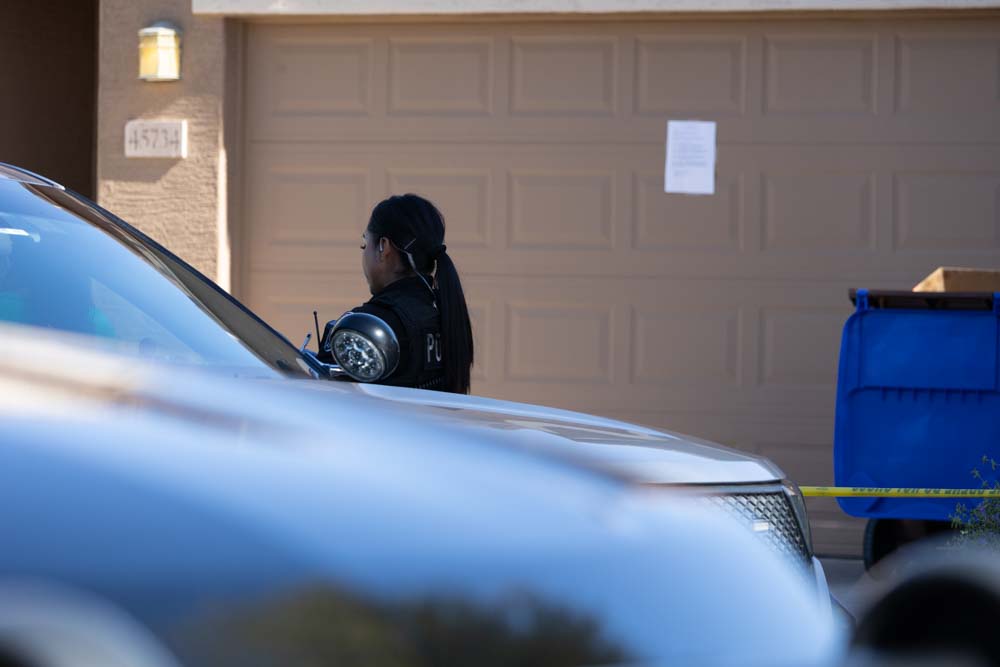
One of the last two people to see Thomas alive was the first person to see him dead.
“It doesn’t make sense,” said Mary T. Dos Marcos, 57, the landlord for the Dirk Street home. She was serving an eviction notice that morning.
She knocked on the door. No response.
She peeped in a window. It seemed quiet. She unlatched the back gate and poked her head around the corner.
“This is disgusting,” she thought to herself as she was accosted by a swarm of flies. “Did they leave the garbage out?”
Then, it hit her.
She let slip a primal scream and stopped herself just short of vomiting.
“I was the first person to see the body,” she said, her voice tinged with horror.
Documenting the condition of the property as any landlord would when a tenant moves out, her cell phone camera was rolling when she turned the corner, and the specter of death filled her screen.
“I saw a face, an eye … and I ran out,” Dos Marcos said. “I’ve never seen a dead body before. No one should see something like this.” She dialed 911 immediately.
For Dos Marcos and her husband, Lawrence E. McFall, the episode was “traumatizing.”
“I don’t like to bring it up,” said McFall, 51, eight months after he became the third person in the span of a minute to stumble across the body on his property. The landscaper, Israel Corona, was second; he chose not to comment for this story.
“It should have never happened,” McFall said. “They were already evicted — that’s what pissed me off.”
Lab work
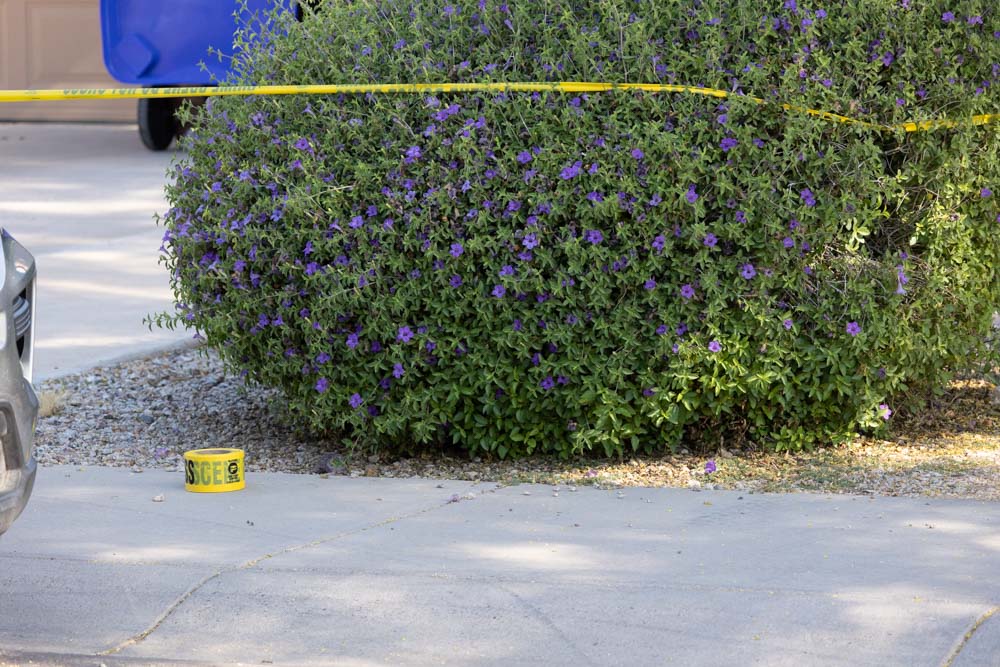
Days-old eviction notices still littered the home’s façade when the authorities arrived to find Thomas’s body in the “early stages of decomposition,” Pinal County Medical Investigator Emily Vecchi said.
Examiners noted a large number of maggots in his mouth, on his head, chest and hips, and on his sweatshirt. Skin was falling off his body, but the examiners said there was “no obvious trauma noted on other parts of the body except the stab wound.” Nor was there blood spatter.
Eleven “unknown pills” were found in his stomach, the medical examiners said. A report from NMS Labs, a federally approved toxicology laboratory in Pennsylvania, that was released to InMaricopa in December, could not conclude what the drugs were. They were not narcotics.
Vecchi pointed to the drugs and the eviction as significant findings in the case, supporting the theory that it was a suicide. While stab wounds account for less than a percent of suicides, documented cases most often involve kitchen knives and impaling the lower abdomen, according to experts.
Or could the toppled ladder hint that it was an accident? It’s all so puzzling. Why, on this 91-degree day, was the decedent wearing winter clothes? Scattered next to him were five warm blankets, investigators said.
Lt. Elliott called the scene “just unusual.”
She said she consulted with her colleagues in other agencies, including investigators and supervisors at the Pinal County Sheriff’s Office and a detective from “a larger agency in the Valley.” The Maricopa Criminal Investigations Department preserved evidence at the scene.
Evidence such as the seven cell phones that were digitally extracted at the Arizona Department of Public Safety’s Computer Forensic Unit in Phoenix from May to July. The phone that was found with Thomas’s wallet and ID card had been factory reset. “All the data from this phone had been deleted,” said DPS Civilian Investigator Sandy Ballard.
The phone found on Thomas’s person could not be forcibly unlocked. “We were not able to extract any digital evidence,” Ballard said.
None of the phones had been used to call 911, the police noted.
“This was definitely a head-scratcher for us,” Elliott said. “A lot of people with a lot of expertise looked at this — people with a lot more homicide experience than we have — and we all came to the same conclusion.”
But Dos Marcos and McFall came to a different conclusion. The landlords theorize Thomas’s family members, who variously lived at the Dirk Street home since 2023, know more than what they told the police. Some of them had been persons of interest in the death investigation, according to police reports released to InMaricopa in December.
A ‘hothead’ and a U-Haul
The authorities only ever named two persons of interest in the Thomas case: his 35-year-old brother Ontwiel Marquies Lane, who lived in the Dirk Street home, and his sister Kaci Varner Richie, 34, a prior occupant. Her name was still on the lease when her brother’s body was found, said the landlords, though she had moved to Gilbert five months prior.
The entire family was steeped in panic.
Lane told officers at the scene “he feared for Kaci’s safety but couldn’t articulate why.” He demanded the police pick her up and bring her to Maricopa. They did not.
Richie, said MPD Officer Yesenia Hernandez, “was really anxious and worried” April 28 when she asked Dos Marcos for a welfare check on Thomas and Lane, one day before the gruesome discovery. Richie said she wasn’t sure her little brother was alive, but didn’t say why.
“She was so panicked on the phone,” said Dos Marcos, who for weeks had been trying to contact Richie, asking her to let a maid service into the home. “Now you’re worried? One week ago, we tried to reach you; you were cold-blooded, saying, ‘I never talk to them. I’m not close to them.’ I felt like she tried to set us up to go to the house and see that.”
Dos Marcos said “the whole family disappeared for a week” before the stabbing.
They may have disappeared from her field of view. But one family member was keeping busy.
- April 24, 5 days before the discovery: Lane is terminated from his job at Amazon for unknown reasons. He later tells MPD Officer Tyler Pappas that was why the family couldn’t make rent that month, but Thomas was employed full-time and had recently been promoted, and two other working adults were on the lease. Neither man was the primary tenant. Euphemia Weekes, a Maricopa property manager, reviewed the facts of the case and said it was impossible Lane missed rent before he was fired from Amazon because a state law requires a landlord to wait five days after a missed payment to evict, and eviction notices were served only two days after his termination.
- April 25, 4 days before the discovery: Thomas goes to work at QuikTrip in Mesa for the last time. He is scheduled to work the following days, says his supervisor.
- April 26, 3 days before the discovery: Thomas calls out of work, saying he was in a car accident. Driving Thomas’s car, Lane and his girlfriend, Shameka McClain, visit a U-Haul dealer in Queen Creek. Then, they visit a U-Haul dealer in Chandler. Then, they visit a U-Haul dealer in Ahwatukee. Then, they visit a U-Haul dealer in Tempe. They do not rent a U-Haul. The couple make DoorDash deliveries for several hours before parking at Circle K at Southern and Mill Avenues, where they sleep for the night, according to Lane. MPD officers reviewed security camera footage from the Circle K and found no sign of either person that night. Then, the officers went to the Tempe U-Haul, which had no record of the couple ever being there. After run-ins with Lane and Dos Marcos, Thomas is never seen alive again.
- April 27, 2 days before the discovery: Lane says he and McClain wake up at Circle K and make DoorDash deliveries for four hours. Then, they go back to the U-Haul dealer in Tempe. Then, they go back to the U-Haul dealer in Chandler. Then, they go back to the U-Haul dealer in Ahwatukee. Then, they go to a nearby Penske Truck Rental. They do not rent a vehicle and resume work for DoorDash. Just before 3 a.m., they park at Wild Horse Pass Casino and sleep in Thomas’s car, according to Lane. Meanwhile, Richie visits QuikTrip for a welfare check on Thomas, to “make sure he was alive,” but can’t find him.
- April 28, 1 day before the discovery: Lane says he and McClain visit the U-Haul dealer in Tempe for a third time. They do not rent a vehicle. They spend the rest of the day making DoorDash deliveries before sleeping in Thomas’s car in the parking lot of Harrah’s Ak-Chin Casino, a five-minute drive from the Dirk Street home at which Lane was a legal tenant.
- April 29, discovery day: Lane is fired from DoorDash for unknown reasons. According to Lane, he and McClain visit U-Haul dealers on John Wayne Parkway (employees confirmed they were there that morning) and Maricopa-Casa Grande Highway (employees here did not). They do not rent a vehicle. They were “just passing through,” McClain said, on the way to yet another U-Haul dealer when they saw police presence at the home and stopped to investigate. Lane exited the car shouting, “Where is my brother?” and screaming hysterically, responding officers said. The neighborhood was not on any direct route to their destination, and Dirk Street is nearly a mile off the main road.
Lane told the police he needed a U-Haul to move out of the Dirk Street home, and the company wouldn’t rent to him because of his poor credit.
It is perplexing to consider why Lane chose to sleep in his brother’s car, and not his own bed. Several Dirk Street neighbors said until the week of Thomas’s death, Lane spent long afternoons tinkering on the Jetta or simply relaxing in the garage, door open, waving hello to passersby. Maricopa police searched the sedan for clues, finding none.
GPS data from DoorDash obtained through a search warrant confirmed Lane made deliveries each of the three days leading up to the discovery of his brother’s body and handled one order that morning before the company banned his account.
One of the Dirk Street neighbors, Joe Frombach, described Lane as friendly. Everyone on the block called him “O,” he said, because of his uncommon first name. Thomas was “less friendly and potentially a hothead.”
But five people who knew him well told InMaricopa Thomas was a happy person.
“The unusual thing is that he was recently promoted at his job,” said McFall, the landlord. “He was on the uprise, in some capacity. He was trying.”
Thomas displayed no signs of mental illness, was nonviolent and never mentioned suicide, said those who loved him, even as he planned to become homeless after the eviction.
Of course he didn’t discuss suicide, one of the relatives said. Because he was murdered.
And she thinks she knows who did it.
Accusations of murder
Dedgra V. Rose-Richie spent a month trying to figure out how her nephew died. It was June 3 when the medical examiner released his cause of death.
Her heart dropped as she scrambled to place a call to Maricopa from her home in Dallas.
“Ontwiel may have stabbed Makaiel,” she told police officers, according to a transcript of the call. “Makaiel would not allow anyone to get close to him, so it would make sense if it were his brother.”
Two days after Thomas’s body was discovered, Rose-Richie said, Lane told her that “he was teaching Makaiel how to defend himself.” At the time, the aside did not faze her.
But what Lane said next would eventually take on a dark new meaning.
“Ontwiel stated that he was teaching Makaiel to do anything to defend himself and grab a butcher knife, if necessary,” Rose-Richie recounted.
Similarly, McFall told InMaricopa that he had a “suspicion about the actual brother who also lived in the home.”
“He had something to do with it,” McFall said confidently.
Lane has a different theory about how his little brother died. Although he agrees with one crucial assessment — Thomas was murdered.
“It was Lawrence, the landlord,” Lane said during a police interview, according to a summary of the interview released to InMaricopa. He allegedly told Rose-Richie he was sure McFall had murdered Thomas, and that he had a video of the killing.
This has never been substantiated. Lane did not respond to requests for an interview.
And there are other theories.
Jason Brown, a Dirk Street neighbor, said Thomas may have had a stalker.
In the six months leading up to his death, Brown saw a white man in his 40s park his dark gray sedan in front of the home several times, getting out of the car to photograph the house. Every person with access to the house was Black, including McFall, who did not send the man. Brown said he warned Thomas about “the photo-taking man,” and Thomas thanked him.
He never talked to his neighbor again.

‘Not considered closed’
The landlords don’t think the authorities did enough.
“Nobody ever got back to me on the results of that case,” said McFall. “I don’t know what happened to the brother…. I don’t know what happened to anyone.”
Dos Marcos said: “Absolutely, they need to investigate it more. I 100% believe they should.”
Det. McCullar closed the case July 12. But Lt. Elliott, who led the investigation, doesn’t consider it closed. Only on paper, she said.
“The determination of the cause of death as a stab wound, with the manner of death ruled undetermined, reflects the complexity of the case,” she said. “Whenever you’re dealing with a situation where there was nobody who saw what happened, you try to piece it together. We explored all the possibilities, and sometimes it doesn’t have a clear answer, and I think that’s where we ended on this one.
“If we received additional information that we could explore and investigate, we would certainly be interested in doing that and trying to solve the puzzle.”
All tips and leads will be thoroughly reviewed and pursued as appropriate, she promised. Until then, the case will stay tucked away in a filing cabinet; lost to the world, perhaps, like Makaiel Michael Thomas.
One year before this article was published — to the day — Maricopa police pulled Thomas over for speeding, somewhere in the city.
Little did anyone know, the next time they saw him, he would be dead.
Maybe, one day, we’ll know why.