

The alarm on the nightstand could wake a neighborhood.
It was the kind of clock sold to rock stars and linemen. Still, it could not pull Matthew Eller from the depth he’d learned to reach. His mother, Susan Eppard, bought it when the other alarms failed, when she stood in his doorway in the Michigan mornings and watched the rise and fall of his chest, unsure whether to shake him or let him be. The siren wailed. He slept on.
“He would go into a coma-like sleep where he couldn’t wake up,” Susan told InMaricopa. “I bought this sonic alarm clock that had a decibel level of a siren, and he could sleep through it.”
Later, after he moved out, she would find the empties. Zip-top bags, light as paper, their prices stamped in a font meant to seem botanical: $12, $22.
“I didn’t have a clue what it was,” she remembered. “But I saw the prices on those bags and thought, well, there’s where all his money went.”
Matthew told her it was an herb, no worse than a strong cup of coffee, the kind that made the day easier.
“He thought it was for energy,” she recalled. At first, he seemed to believe it. Then he began to crave it. His hands shook. The sleep deepened.
Matthew was the youngest of Susan’s six children, the one who made her laugh when the others grew too busy to try. “He was just always so full of life, always healthy, energetic,” she said. “He had the most charismatic personality, you know, lit up a room.”
She paused to envision her last holiday with her son.
“Every family gathering now just screams with his absence. It can’t be a happy Christmas or Thanksgiving anymore. It’s all just the absence of Matthew.”
He died Nov. 10, 2021.

The autopsy left no doubt. Cause of death: The toxic effects of mitragynine, the chief alkaloid in kratom. Nothing else. No fentanyl hidden where even the cautious miss it, no cocktail of pills. Just the powder he thought was safe enough to buy at a corner store.
“I had never heard of it until he moved out,” Susan said. “I didn’t even know he was using it. And even after I researched it, I had no idea it could kill him.”
Susan Eppard has never been to Maricopa. But when InMaricopa wrote about another family dealing with the effects of kratom, she reached out. She is something of a nationwide advocate, trying to raise awareness in her son’s name. Matthew.
People will tell you kratom helps, eases pain, quells anxiety, reins in the cravings left behind by opioids. Susan has heard it all. She keeps her face neutral when they say it, the way you do when you’ve buried your ambition for a repeat debate and don’t care to exhume it.
“I’m actually in a group with hundreds of people whose loved ones died from kratom,” she said. “And many of them, it was just the powder. Not the high-potent stuff. Just the powder.
“Kratom sucked his soul out before it even took his life,” she said.
Arizona’s law and its loopholes
Closer to home, in Arizona, the line between “natural supplement” and “street drug” has been sketched in statute for years, though you wouldn’t know it stepping into a vape shop. The Kratom Consumer Protection Act, passed in 2019, made it illegal to sell any product containing more than 2% 7-hydroxymitragynine, the concentrated alkaloid known as 7-OH. The law was meant to draw a boundary: Kratom leaf could stay, the stronger synthetic products could not.
But the shelves tell a different story.
At The Smoker’s Edge on John Wayne Parkway, clerks said they could barely keep 7-OH in stock.
“It sells out fast,” a clerk admitted as InMaricopa staff went inside to see how easy it is to buy 7-OH.
“We’re having trouble keeping it.”
Few spaces remained.
At Vape Etc. on John Wayne Parkway, a young clerk bagged a set of small, pale tabs with the same casual speed he used for bongs and vape juice. When asked if he’d ever tried them, he laughed. “Hell no,” he said. “I stay away from it. It’s easy to get addicted to.”
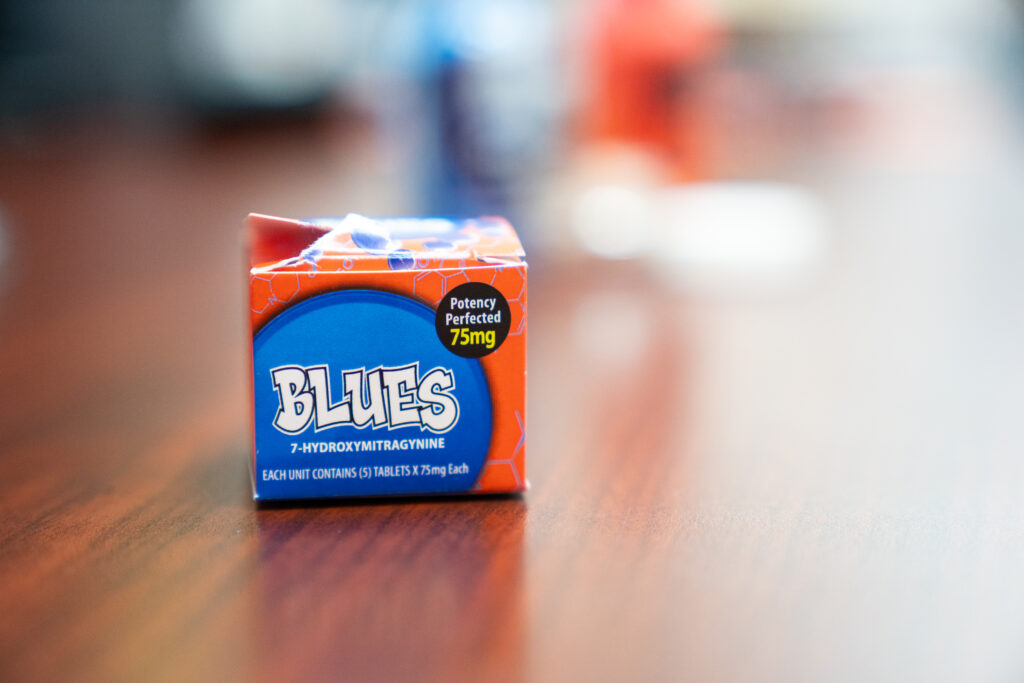
A reporter left with 7-OH tablets in hand. On the back of the pack was a stark label in all caps: “WARNING: Addictive. MAY CAUSE DEPENDENCE. Kratom and its derivatives may cause addiction and serious side effects.”
Red Star Vapor at Edison Pointe doesn’t carry 7-OH, a manager said. Distributors are offering, but so far, they’ve rejected them.

InMaricopa shared its findings with Matt Lagrange of the Global Kratom Coalition, an industry-backed group that bills itself as both advocate and watchdog. The coalition funds lobbying to preserve access to kratom leaf, while publicly urging a crackdown on synthetic products like 7-OH. Its members include vendors, consumers and a rotating bench of scientists who argue the plant has been used safely for centuries.
“Yes, those products are above the legal limit,” said Lagrange, confirming the products InMaricopa bought shouldn’t have been sold.
“The law is clear,” the Arizona Department of Health Services said in response to an InMaricopa request to verify that the drugs were in fact over the legal limit. “No product may contain a level of 7-OH exceeding 2% of its alkaloid fraction.”
Yet the products sit on shelves anyway, marketed with names that wink at prescription opioids, sold at a markup when compared to traditional kratom. Enforcement is more theory than practice.
InMaricopa’s findings sparked an ADHS investigation. The agency also issued a statement explaining that the Arizona Kratom Consumer Protection Act does not mandate regular inspections or testing but instead prohibits products above the 2% 7-OH threshold.
Enforcement is typically triggered by consumer complaints or suspected violations, with local law enforcement able to act on a case-by-case basis. Retailers and distributors are expected to use independent labs to ensure compliance.
State Rep. T.J. Shope, the Republican who represents Maricopa, said he believes Arizona may need to go further than the current law.
“At this point, we’re reviewing the FDA’s recommendations and considering whether legislation may be needed to bring Arizona into alignment. At the very least, we want to ensure that children cannot access these items. I’ll be monitoring the situation closely as I prepare legislation to introduce when the session begins in January,” said Shope in September.
Enforcement at the local level has been just as passive as the state. Responsibility for the Arizona Kratom Consumer Protection Act rests primarily with ADHS, with potential involvement from the Attorney General’s Office. Maricopa Police Department acknowledges it has not conducted any targeted enforcement because it hasn’t been asked to.
“We stand ready to assist if formally tasked by state authorities or if a direct public safety threat emerges,” said police spokesperson Monica Williams. Until then, the law remains largely unenforced at the street level.
When reporters reached Brian Chung, owner of Vape Etc., he sounded weary.
“I don’t make 7-OH,” he said flatly. “I don’t make it in my kitchen or put it in the store. That’s important to know. My distributor pushes the stuff in. Every week a new rep comes and stocks us up.”
Just a few months ago, it was hard to keep stocked, said Chung.
He said he gave it only a small shelf, “not like other products that take up space.” But in a small shop, it’s hard to argue with the demand.
“They tell me, ‘You should sell our product. This could be profitable,’” Chung said. “No one ever explained the state laws to me.”
Two other local vape shops, Cloud Slingers and The Smokers Edge, both sell the same 7-OH. Owners of those stores did not respond to requests for comment.
According to the CDC’s State Unintentional Drug Overdose Reporting System, kratom has been detected in thousands of overdose deaths nationwide, with 2,343 fatalities between 2020 and 2022 in which the drug was listed as either the sole or a contributing factor. ADHS reported mitragynine, the primary alkaloid in kratom, was detected in 19 fatal overdose cases in 2023, the most recent data released. Many of these deaths involved other substances.


A national fight over 7-OH
This summer, federal regulators finally moved. On July 29, the FDA recommended scheduling concentrated synthetic 7-OH as a controlled substance, explicitly drawing a line between kratom leaf and the derivative that scientists say is up to 13 times stronger than morphine. Days later, Florida’s attorney general followed with an emergency ban, tightening loopholes almost as fast as the industry could find them.

The action was hailed as decisive.
“We saw it with spice. We saw it with synthetic tea,” said Global Kratom Coalition Executive Director Matthew Lowe during an online panel with experts in August. “Without clear scheduling, these markets never clean themselves up. With it, real enforcement, real education, it can.”
Added another panelist: “The DEA’s role is critical. If 7-OH becomes a controlled substance, then local officers are empowered to act. Without that, they can’t touch it.”
The FDA called its move a matter of protecting the public from what it warned could be the “fourth wave” of the opioid crisis.
At a closed press briefing in August, the Global Kratom Coalition gathered reporters to make what they called “a critical distinction.” Their target was not the leaf itself but the concentrated synthetic byproduct now being sold in Arizona vape shops under slang names:
“Blues.”
“Perks.”
“These products are not dietary supplements. They’re opioids,” said Lowe. “Thirteen times stronger than morphine, sold for $6 at your corner store. If you think it’s crazy to have morphine sold in gas stations, the same logic applies here.”
Dr. Charles White, a pharmacologist at the University of Connecticut, offered an analogy designed to land with the public: “An apple seed contains amygdalin, which can turn into cyanide. Imagine someone extracted it, converted it to pure cyanide, and sold it as an apple-flavored candy. Is that still an apple? No. And you can’t rely on safety data from apples to make it seem safe.”
The coalition underscored the difference in pharmacology. Kratom leaf contains about 50 alkaloids; mitragynine accounts for roughly two-thirds. By contrast, synthetic 7-OH is almost pure alkaloid, up to 100 times the concentration found in natural leaf.
“Kratom leaf and 7-OH,” White said, “don’t even live on the same planet in terms of risk.”
Panelists pointed to Florida as a model. After its initial 1% cap was exploited with “Florida compliant” 7-OH pills, the state’s attorney general tightened the rule within days, lowering the threshold to 0.04% by dried weight. “Regulators there knew people would look for loopholes,” one panelist said. “They were agile enough to close them. That’s the kind of vigilance it takes.”
Others called for a registration system: products logged with certificates of analysis, packaging that avoids cartoons or candy flavors, clear dosing tools to avoid accidental overdoses. “You could walk into a store,” one advocate said, “and immediately see if a product was approved or not. That’s the level of transparency we need.”
Yet even within the coalition, there was no path forward for 7-OH itself. “We’ve looked really carefully at these products,” one panelist said. “There’s no way you can regulate them safely. The risk is too high. They should not be sold in gas stations, in smoke shops, in convenience stores.”
A mother’s mission
For Susan Eppard, the distinction feels academic. Her son died from mitragynine itself, not from a derivative. To her, both belong under the same ban.
“What bothers me about the FDA,” she said, “is they’re strictly going after 7-OH. But it was the kratom plant that killed my son. They’re missing the boat.”
She has no interest in sitting down with the trade groups who defend the plant while disavowing the pills.
“They lie, right in front of lawmakers, even when the toxicology reports are in front of them,” she says. “I don’t want to deal with any of them.”
Instead, she keeps traveling, testifying in hearing rooms in states she barely knows, joining hundreds of other families who have lost someone.
“It’s my entire life now,” she admits. “I don’t get paid. I just try to make sure these laws get passed.”
For now, Arizona’s rule sits on the books: 2% 7-OH, no more. But in practice, that rule is scarcely enforced. Vape shops sell out of substances above that limit with little concern from state regulators. Distributors send reps weekly, say Maricopa vape store owners. Stores sell out before the reps return. Mothers bury sons.
And in Maricopa, a clerk slips pale tabs into a nondescript paper bag. Tabs he wouldn’t dare take himself, as the line between supplement and opioid blurs one sale at a time.