
If you have seen a post about a serial killer on the loose in Maricopa, local police want you to know it is a scam.
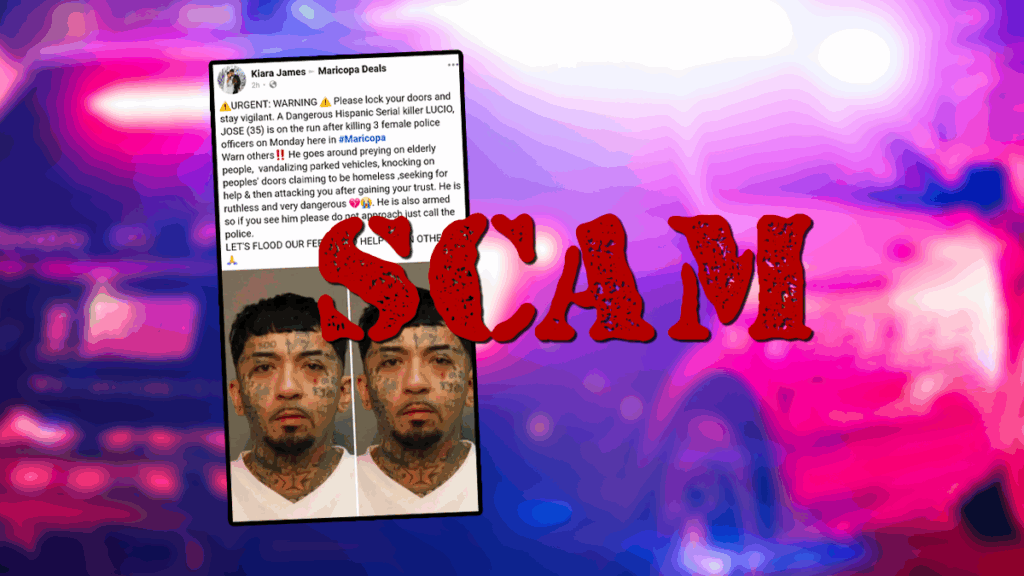
A Facebook user under the name Kiara James shared an image today of a heavily tattooed man’s mugshot warning people:
“Please lock your doors and stay vigilant. A Dangerous Hispanic Serial killer LUCIO JOSE (35) is on the run after killing 3 female police officers on Monday here in #Maricopa
Warn others! He goes around preying on elderly people, vandalizing parked vehicles, knocking on peoples’ doors claiming to be homeless, seeking for help & then attacking you after gaining your trust. He is ruthless and very dangerous. He is also armed so if you see him please do not approach just call the police.
LET’S FLOOD OUR FEEDS AND HELP WARN OTHERS”
Concerned citizens have called into Maricopa Police Department dispatch to ask about the post, department spokesperson Monica Williams told InMaricopa. “This appears to be a post that people have shared in multiple communities and are changing the location based on where it’s posted.”
Flooding feeds is exactly the point of this scam — keep reading to find out how it works.
The Kiara James account is suspiciously empty, with only a profile picture added just recently on Feb. 4. It only likes two profiles: both scam profiles based out of Zimbabwe.
Lucio Jose is a real man who was recently arrested, according to Mugshots.Zone.
That arrest was not for murder, however, but stemmed from a laundry list of traffic violations in Chicago including driving with no valid registration, driving with a suspended license, operating an uninsured vehicle, unlawful possession of narcotics and a taillight violation.
James turns commenting off so that suspicious locals can’t call out the scam, and the only option for those who fall for it is to hit “share.”
The purpose of this scam is to coerce unsuspecting samaritans to share the posts in large numbers. Then, the scammer edits the post to become a Bitcoin scam or a phishing link to steal people’s personal information. Sharing the post can pose a false sense of security to your friends and family that the Bitcoin or phishing scam is legitimate because you shared it.
Here are a couple of red flags to look out for before sharing posts involving wanted people:
- Is there a lack of detail on the author, location or incident?
- Are comments turned off?
- Has a trusted news source, or police department, covered this incident?
- Does the user use a hashtag in front of the city’s name? If so, be wary.
This isn’t the first time people have taken to local groups with hoaxes, replacing the wanted serial killer with a fake missing kid poster, typically using images of hurt young children.
There are ways to determine if a missing person poster is real, and the National Center for Missing and Exploited Children suggests looking for the following red flags to spot misinformation:
- The information on the child does not come from NCMEC, an official law enforcement agency or another credible news source, such as your local or national news.
- The poster or post contains misspellings, improperly used words or errors in syntax.
- The post does not ask you to take the appropriate action or doesn’t share how you can take action.
Good missing person posters should include:
- A child’s name
- The date they went missing
- The location they are missing from
- The law enforcement agency handling the case, its phone number or NCMEC’s 24/7 hotline, 1-800-THE-LOST





![Global Water Resources told customers in a Friday letter its proposed Maricopa rate hike has been reduced to about 7%, with any new rates unlikely to take effect before 2027. [InMaricopa file]](https://inmaricopa.com/wp-content/uploads/2026/02/Global-Water-180622-_RMC1562-300x200.jpg)