


Maricopa Unified School District received an update Wednesday on two planned K-8 schools that could move into design and construction hurriedly to stay ahead of rising materials costs. School board members feared jumping the gun, while district staff made a case that rushing the phases could save millions of dollars.
Both schools are yet unnamed, so they’re differentiated only as K-8 Nos. 1 and 2 in official documents and discourse.
Sorrento school still on track
K-8 No. 1 broke ground in Sorrento May 15. That school is scheduled for completion in July 2026. It will be the district’s first campus to follow the K-8 model, which combines elementary and middle school grades on a single campus.
School board Vice President Patty Coutré remarked that the Sorrento campus marks “our first K-8 school” and said “people are already excited to know what we are going to name it.” Coutré added that a naming committee will be assembled to include “a variety of our stakeholders, including community members.”
Slated to open for the 2026-27 school year, the $39 million, estimated 90,000-square-foot campus will accommodate up to 1,000 students and is being funded through a combination of state grants, local bond support and taxes.
Rising costs could impact 2nd school
During the meeting, MUSD Chief Financial Officer Jacob Harmon provided a construction update on four ongoing projects tied to the district’s bond program. He outlined the current timeline and projected enrollment growth that has prompted the district to consider accelerating planning for the second K-8 campus.
According to Harmon, K-8 No. 2 and a Desert Sunrise High School expansion are both awaiting potential state grant approval, expected to be finalized in December. If approved, the projects are on track for completion in July 2028. However, Harmon recommended accelerating K-8 No. 2’s construction to allow for an earlier opening.
“If we accelerate the timeline of ‘K-8 No. 2’ and successfully open in fiscal year ‘28, we’re able to stay ahead of that projected growth without additional strain on our existing schools or more portable classroom building,” Harmon said.
Harmon is recommending that the board move forward with the planning and construction before the money is in place. He cites “financial efficiency” (a bureaucratic way of saying construction costs are rising) as a reason for rushing through the design phase.
“Construction escalation is about 5% annually,” said Harmon.
The Phoenix metro is at the low end of construction cost increases. Phoenix recorded the second-lowest increase in construction costs among major U.S. cities, according to a new report from Rider Levett Bucknall. Phoenix saw a year-over-year change of 4.1%. The rising cost is chalked up to tariffs, inflation and labor shortages.
If MUSD doesn’t move quickly, Harmon estimates it could cost the district about $2.3 million more.
Board member: ‘Disrespectful or irresponsible?’
Board members peppered Harmon with questions about this risk. What happens if the state does not approve funding in time? How sure are we that the funding will be there?
Board President Robert Downey asked if the district would be taking a financial risk. “We’re thinking of spending money at risk,” he said.
Harmon agreed that planning would begin before the state officially approves the project, but he said the risk is small.
“There’s still about $2.5 million of cost in planning and designing for that year,” Harmon said. “If we’re not approved in December, then likely we’d be approved a year later … that at risk is not a long-term risk. It would be more a short-term risk.”
Coutré asked if the state might see the early planning as a problem.
“Would the state perceive our action as disrespectful or irresponsible?” she asked.
Harmon said a representative from the state’s new school construction division told him that early planning was acceptable.
“This is not a process that they’re adverse to,” said Harmon.
Additional uncertainties
Downey asked what would happen if the district had to purchase land. Harmon explained that the district is asking the state to approve a donated parcel. “We’re pursuing an application with the state on one of our donation sites,” he said. “Their next governing board meeting is in August.”
He added that the process to approve donated land takes about four months and entails a series of environmental and safety studies. “If you finish phase one and two, it’s likely that the next phases won’t be an issue,” he said.
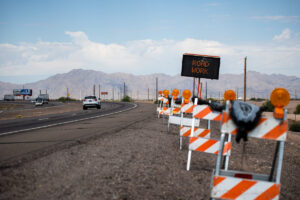
Board members also asked about road construction near the new Sorrento school. Farrell Road needs to be improved to provide full access to K-8 No. 1.
Downey said some community members have asked why it hasn’t been completed yet.
“Why isn’t it fixed? Why is the school paying for it?” asked Downey.
Harmon said MUSD is ready to move forward with the roadwork, but federal approval is needed because a canal runs through the area. “There’s a [Maricopa-Stanfield Irrigation] canal there that’s actually owned by the U.S. Department of Reclamation,” he said. “We’re closer than we’ve ever been. The design has been approved.”
Superintendent supports early action
While some board members had concerns about the district getting ahead of approvals, Superintendent Dr. Tracey Lopeman noted that planning early has helped the district in the past. It worked for Desert Sunrise High School.
“When the state allocated another $18 million, there was no delay because we already had the plan,” she said. “This is a similar application of the resources that we have.”
The board will vote at a future meeting on hiring a contractor, architect and project manager for K-8 No. 2.


![Western Pinal Justice of the Peace Patricia Glover speaks during a City of Maricopa Republican Club on May 23, 2026. [Monica D. Spencer]](https://inmaricopa.com/wp-content/uploads/2026/05/20260529-spencer-teeple-republican-club-1-4-300x200.jpg)