
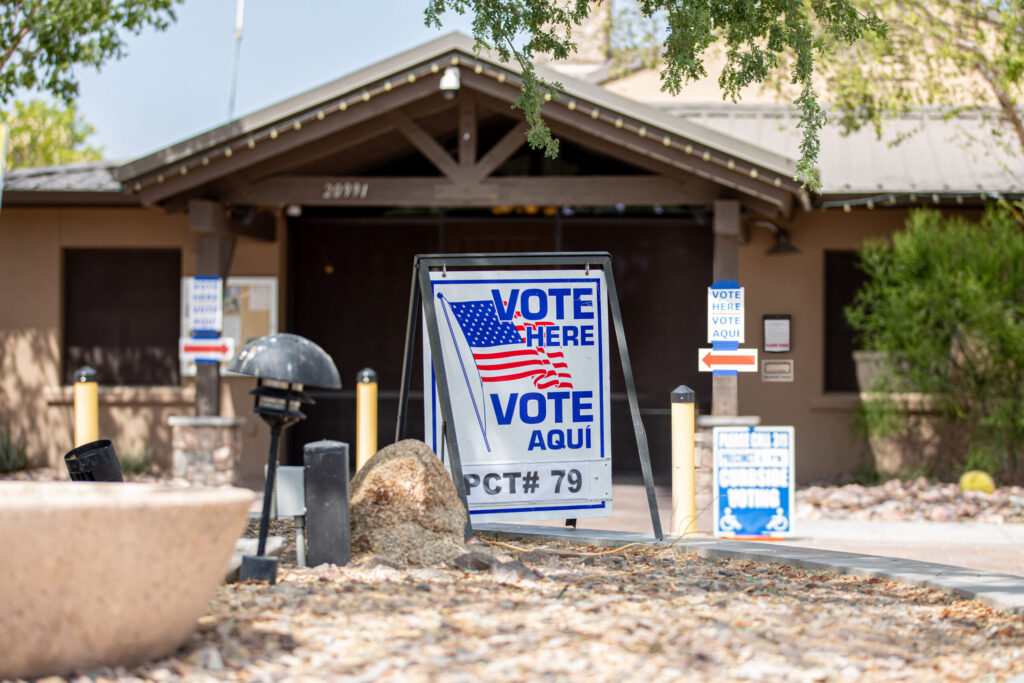
In Maricopa, like anywhere else, candidates pine after voters. Does the electorate reciprocate that courtship?
Nope. It’s a more one-sided love story than 500 Days of Summer. And, gosh, that was a depressing flick.
If every Maricopa city voter who blew off the primary election packed into the Footprint Center for a Suns game, they’d fill the arena twice — with 900 fans left standing outside.
Those folks would miss watching Ryan Dunn go boom or bust, but that’s just what you get in a city where, in 2024, it feels like more people participated in NBA All-Star voting than in the election that decisively set up the next four years of leadership in Maricopa.
Brayan Sandoval, a 38-year-old Los Angeles transplant living in Cobblestone Farms, was among more than 45,000 registered voters living inside Maricopa city limits who decided to sit this one out.
“I didn’t even know where to go vote,” Sandoval said. He cared enough to think about voting, but not enough to find out where his polling place was. And he’s no church of one in that regard. You know, finding a reason to care.
This isn’t Australia, where you can go to jail for being too ballot shy. Here in the U.S. of A., you’re more likely to go to jail for casting a vote than playing electoral hooky — Adrian Fontes’ Election Integrity Unit is fielding more than 2,000 complaints and referrals related to election crimes among people who voted in the 2020 election alone. That, compared to zero complaints against people who didn’t.
Former President Donald Trump lost Arizona by 10,000 votes that year, in a state that, it turns out, has 40,000 people on its voter rolls who never proved they were American citizens.
And there’s our first reason why so many more Maricopans voted for Kevin Durant than Kevin Cavanaugh. At an Arizonans for Secure Elections roundtable the day after the primary, former Gov. Jan Brewer said “some voters choose to stay home because they have been told not to trust the elections.” But that is, in its narrowest scope, a statewide issue — so, why is Maricopa’s turnout still so much worse than the rest of Arizona?
Because elections are weird here.
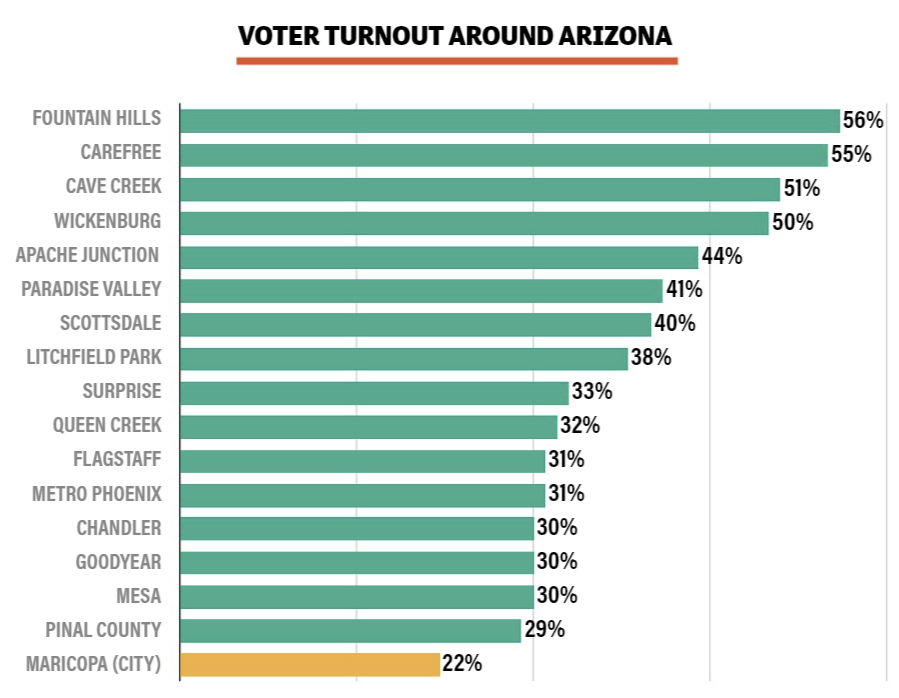
Sure, primary participation came up short of expectations across the nation. But Maricopa, with its worst turnout in the last eight elections, ranked lowest among all Pinal County cities.
And not for no reason.
Tell it to me straight — how weird are we?
There were still photons of sunlight bouncing around the summer sky when InMaricopa projected the winners on election night. With half of precincts still left to report, it was already an obvious landslide.
None of the races were close. Practically speaking, they may as well have gone uncontested.
Clearly, Maricopa voters are laissez-faire when it comes to guiding this young city through its belle époque. Political experts studying voter behavior in the Phoenix metro pointed to six reasons for this:
- Hardly anyone is from here.
- The city is young.
- The people are young.
- A negative feedback loop of fundraising.
- Discontent with candidates.
- Apathy.
In Maricopa, turnout for the July 30 primary election was 22% — down from more than 27% in the 2020 primary election. On the Ak-Chin Indian Community, it was less than 15%.
Incumbents all won their seats back at City Hall by double-digit margins. Mayor Nancy Smith outperformed challenger Leon Potter by nearly 30 points; Vice Mayor Amber Liermann and Councilmembers Eric Goettl and Bob Marsh combined for 75% with challengers Chrystal O’Jon and Le’On Willis garnering 14 and 11% support, respectively.
Sounds like a landslide, alright.
But if turnout was a smidge higher — let’s say 26%, still lower than four years ago — O’Jon could have statistically defeated the incumbent Goettl. Maybe if she knocked on a few more doors?
Chuck Coughlin, President and CEO of HighGround in Phoenix and a five-time winner of Arizona’s Best Political Operative, said a reason for languishing turnout is because Maricopa “is more of a commuter community.”
This so-called “bedroom phenomenon” detaches voters from local politics in a city where 4 in 5 adults work and therefore spend most of their waking hours in a county other than the one where they live. That, on top of the fact that one-third of the city’s population has moved here during the last two election cycles, according to U.S. Census Bureau data.

An NPR analysis of U.S. registered voter data in 2018 found “transient” people — those who have moved recently between states or countries — are less likely to vote and “often feel less invested in local elections.”
In more than a dozen interviews, nonvoters expressed they don’t feel like their vote matters, especially when setting the weight of their vote against the population growth they observe in their daily lives in the city.
Stuck in our salad days
Kale Armstrong didn’t vote in the primary election. But he is going to vote in “the big one.”
The Glennwilde 21-year-old is part of the Generation Z voter bloc Coughlin says is less likely to vote. Election canvassing in Pinal County strongly backs this trend with the most active precincts centered in retirement communities.
“My parents were trying to get me to vote,” Armstrong said. “I didn’t know enough. You have to dig deep and look into some articles about who the [candidates] are and what they stand for. There isn’t enough information out there to figure out who to vote for, at least for the younger generation.”
Now preparing to cast his ballot in the Nov. 5 general election, Armstrong has quickly started feeling the opposite — he’s inundated with information about the candidates he’s meant to carefully choose between, and it’s more information than he can digest.
“I have mail sitting on my bed right now about the general election,” he said from his Glennwilde bedroom Sept. 3. “You don’t see that with the local guys. And I, personally, won’t vote unless I have enough information to go into that voting booth and know exactly what I’m voting for.”
Armstrong’s Maricopa Wells precinct, where the median age is 36, saw a 24% turnout in July. In the adjacent Province precinct, just across Honeycutt Road, the median age is over 65 and turnout was highest in the city at 33%, according to a Pinal County canvass.
Precincts in 55-plus communities saw the highest turnouts in the county — Saddlebrooke Ranch (59%), Superior West (57%), Saddlebrooke West (55%), Saddlebrooke East (53%) and Mountainbrooke Village in Gold Canyon (51%).
Elections experts agree older voters are more likely to vote with low information. Younger voters, not so much.
A tale of two cities
Fountain Hills, like Maricopa, is a bedroom community about 35 miles from downtown Phoenix. Unlike Maricopa, it’s just a town, not a city. Fewer than 24,000 people live there, compared to more than 75,000 here.

Both municipalities held mayor and council elections on July 30. In Maricopa, turnout was 22%. In Fountain Hills, it was two-and-a-half times higher, 56%.
Candidates in Fountain Hills’ mayoral election spent a combined $170,000. Scottsdale’s three candidates spent more than $1 million. Dollars spent in Maricopa’s mayoral election? Zero.
Why?
“The average Fountain Hills voter is 10 years older than Maricopa voters,” Coughlin said. “Older voters tend to vote at a higher proportion.”
But there’s a lot more to it — insipid candidates, poor messaging and voter apathy. Oh, and this annoying little thing called being broke. It’s the same annoying little thing that tanked Sheriff Mark Lamb’s Senate bid against Kari Lake.
Seven citywide candidates in Maricopa raised a collective $17,356, according to Arizona Secretary of State documents. Sure, that’s enough to buy a golden Apple Watch, so, nothing to sneeze at.
But the vast majority of those dollars came from the candidates’ own pockets, not from motivated members of the public.
Liermann’s campaign raised $3,806. Of that, a paltry $355 came from donors, including $100 from fellow City Councilmember AnnaMarie Knorr. Liermann at one time paid the campaign $2,341 from her personal account.
Willis’ campaign raised $1,231, with $991 from his own bank account and the remainder from his campaign manager, Aubrey Morris. Only O’Jon grazed the deep pockets of an out-of-town PAC, getting a $1,000 nod from the Our Voice Our Vote organization in Phoenix.
The local org that has donated most to Joe Biden “is the largest Black organizing group in the state,” said spokesperson Rachel Needham.
Sena Mohammed, executive director of OVOV, said her goal is “to support progressive Black leaders running for elected office in local, state and national races.”
Calling support of O’Jon a “natural choice,” Mohammed said the candidate from Senita “first got our attention when she founded the Black Maricopa Chamber of Commerce and has consistently demonstrated that she has what it takes to be a local leader and to fight for our shared goals.”
Mohammed said O’Jon would have “truly made a difference” for Black people in Maricopa. InMaricopa contacted O’Jon July 24 for comment about the endorsement. She never responded.
O’Jon paid two of her own nonprofits with money from her campaign coffers — $972 to the Black Maricopa Chamber of Commerce and the Maricopa Debutante Organization, a teen mentorship outfit.
Diversity, equity and delusion
OVOV liked O’Jon because she represented diversity, in the traditional sense. Experts like Coughlin say a lack of diversity could be a factor in hampering voter turnout, but not the kind you’d think.
In the Scottsdale City Council election, it was a crowded field of nine aged 21 to 79 representing starkly opposing factions.
Among them, a former Arizona House rep, a former Arizona Republican Party state treasurer, a Fox News personality, two high-ranking corporate executives and two former city commissioners.
Diversity of age? Check. Diversity of thought? Check. Leadership experience? Check.
Together, the candidates raised $1,004,307. Some touted their governing experience motivated people to vote — and to spend.
Even in tiny Fountain Hills the incumbent Mayor Ginny Dickey is a former assistant director of the U.S. Department of Environmental Quality with a 40-year government tenure to boot. She faces Gerry Friedel, another experienced politician, in a November runoff. In the primary election, she bested Joe Arpaio, the longtime Maricopa County Sheriff and former U.S. Senate candidate.
Dickey was endorsed by virtually every top local official in the metro — the mayors of Phoenix, Avondale, Mesa, Tempe, Apache Junction, Chandler, Gilbert, Scottsdale, Paradise Valley and Carefree, to name a few.
In Maricopa’s race for mayor, a city more than triple the size of Fountain Hills, no candidate was endorsed by any such person. Neither candidate filed a campaign finance report.
“I think you are on to something with the funds raised being related to turnout,” Dickey told InMaricopa during an Aug. 21 interview. “If people care enough to donate, they will vote.”
And the inverse is true. Case in point.
Challengers in Maricopa elections were a college student with no political experience, a retired grade-school teacher who lied about serving in the U.S. Air Force — also with no political experience — and a tax preparer who was elected to the city council more than a decade ago and quit halfway through his term. All seven municipal candidates were old enough to be AARP members.
As Coughlin says: “Inexperience begets inexperience.”
Just like high school
No wonder, then, why all the city council hopefuls together raised less than one-sixth of the money pulled in by a single candidate for the same office in a nearby town three times smaller.
“I take it as a serious job,” said Maricopa City Councilmember Vincent Manfredi. “Other people take it as a hobby.”

Those hobbyists aren’t adding any desirable traits to Maricopa’s political gene pool, Coughlin said.
“People don’t move to Maricopa to run for the city council,” he said. “They move for some other reason and say, ‘Sh*t, this is a big town, maybe I should be involved.’ A lot of people do this these days, for their own popularity’s sake, like high school.”
In more established cities, even much smaller ones, this isn’t the case. Look no further than Fountain Hills.
Dickey’s $45,434 came entirely from in-state donors and PACs. Same for Friedel’s $44,819 war chest. Arpaio raised $83,443 from individual donors in and outside Arizona.
“A large budget allows for more exposure, which could contribute to turnout,” Dickey said.
Goettl had the largest budget in Maricopa this year after pulling in $7,516, more than three losing candidates combined. Two-thirds of the money came from his own pocket, including a personal loan, and the rest came from “donations solicited by me from people I knew,” he said in a candid interview.
“I have mixed feelings on the turnout,” Goettl said. “There always has been, and for good reason, a push to get more voters to the polls. That’s the democracy part of our republic. People have their greatest voice in that polling booth.”
By the same token, he said, turnout by way of ignorant voters “waters down the votes of people who have paid the price to understand the issues.” If people vote thoughtlessly, it can lead to “serious problems.”
Overall, Goettl said low voter turnout was an indicator that the constituency was satisfied with the status quo. As Coughlin put it: “I’m not going to bother to cast a vote unless there’s a crisis. Satisfaction draws apathy.”
Both men suggested, barring a vote of protest, municipal elections should expect low engagement. That still doesn’t answer why turnout in Maricopa was so much lower than virtually every comparable city in the state.
An El Paso situation?
The Texas Tribune’s dissertation on low voter turnout in El Paso after the city recorded a record low 11% turnout in Texas’ primary election this year found an added layer of nuance — elections in which voters are dissatisfied with both or all candidates also breed apathy.
El Paso is the farthest major city from its state capital in the country — a nine-hour drive to Austin that’s 70 miles farther than San Diego to Sacramento — and voters there are consistently frustrated by neglect at the state level and tepid local candidates, the Tribune reports.
The people want to protest. But they have no one to vote for in protest.
Sound familiar? Maricopa and the albatross around its neck, State Route 347, are afterthoughts in the mind of a state government just 35 miles north in a single U.S. state four times the size of Belgium.
Ouch.
And approval polling could suggest this indignation puts people off voting entirely, even if they’re unhappy with the status quo.
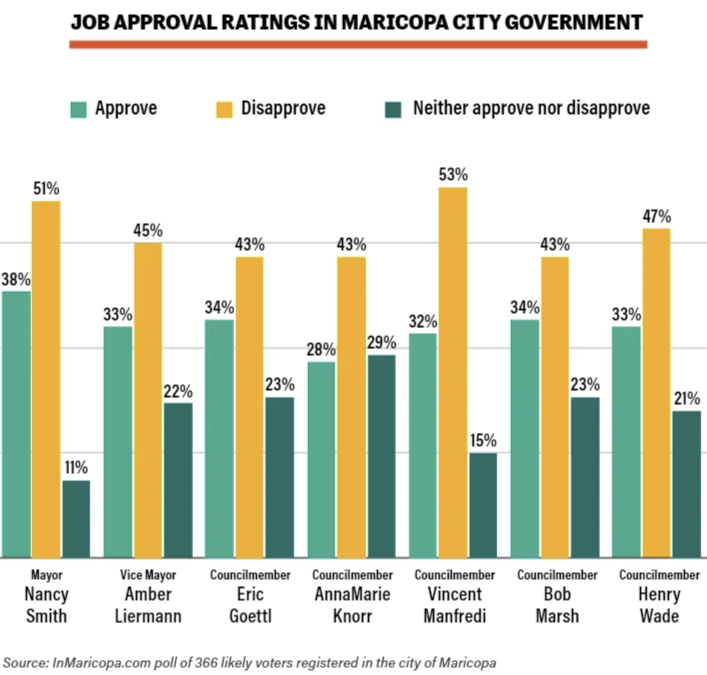
InMaricopa polled 366 registered, likely voters in Maricopa in late August and found the Maricopa City Council that was just reelected in a landslide has worse than a 33% approval rating.
Coughlin asserts “local governments’ favorability ratings far exceed state and most federal governments.”
Maricopa might be an exception. Goettl said on the campaign trail he had to contend with “thousands of individuals who don’t like the growing pains, who are scared to lose the neighborhood feel we have currently.”
At times, he even questioned if his pro-growth platform was a winning strategy, but ultimately concluded the dissenters were “an echo chamber,” queueing up to bark their gripes while the silent majority sat contently by.
Coughlin likes this theory.
“They don’t want any growth. They don’t want any more apartments. They’ve had it — keep everybody else out,” he said. “It’s a minority of people making most of the noise.”
In the rear-view mirror, it’s hard to tell if that’s the case, or if we’re dealing with an El Paso situation.
The (never?) ending cycle
Interviews with nonvoters found some shrugged off the election because it didn’t feel like a democratic choice at all. Half the elected government — Goettl, Knorr and Smith — were appointed to their offices, a “selection rather than an election,” said one voter.
Knorr, now the only councilmember to have never won a city council election, had the lowest favorability rating in the August job approval poll at an eye-watering 28%. Smith, meanwhile, had the second-highest rate of disapproval at 51%.
The nonvoters also pointed to what they called groupthink on the council, where there hasn’t been a non-unanimous vote in the last year.
So, when will voter turnout in Maricopa start trending upward? The city, if no one else, would like to see it.
“The City of Maricopa encourages all residents to take an active role in the democratic process by participating in elections and exercising their right to vote,” city government spokesperson Monica Williams said Sept. 5.
But we’re caught in this vicious cycle — more turnout requires more educated voters, but that won’t happen unless candidates effectively get their message out. That requires money, which requires fundraising, which requires educated voters.
And we’re back at the start.
Only when a government becomes too Kafkaesque will spurned voters migrate from Facebook comment sections to the polling booths, Coughlin said.
But in Maricopa, he insists, it’s just growing pains. And a touch of that youthful naïveté.
“As the community gets older and has more experienced people on the council, turnout will incrementally go up,” he said. “It will go up. It does inevitably.”




![Maricopa Police Chief Mark Goodman speaks to Maricopa City Council while presenting his department's annual report on April 7, 2026. [Monica D. Spencer]](https://inmaricopa.com/wp-content/uploads/2026/05/GOV-Crime-Stats-by-Monica-D-Spencer-300x200.jpg)