

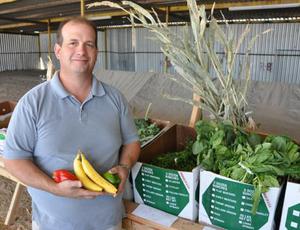
He had a happy family and a good paying IT job with US Airways. Other than long commutes and missed time with his family, there was not much Maricopa resident Dominic Calderone could complain about.
Then the bad news came.
A representative from the airlines called Calderone and told him they had decided to eliminate his position. “I was shocked,” Calderone said.
Out of work for two months and having little success in finding a job that suited his needs, Calderone had gone with a buddy to a wholesale store for restaurants. There he found his way out of a stagnant situation-a 50-pound bag of onions for $6.
He thought to himself, “I just bought three onions for almost $2 a few days ago. How is it these types of deals are not available to the regular consumer?”
Calderone decided to act on that thought. He did a little research and discovered he could buy produce at low prices and then pass along those savings to the consumer. “I found I could sell many items for 50 percent less than a grocer and still turn a small profit,” Calderone said. However, he needed a testing ground for his idea.
So he set out with about $50 worth of produce to a small swap meet held on Papago Road, just a few miles south of State Route 347. “I took just the basic items to make salsa and sold out in no time,” Calderone said.
Since that initial run, Calderone has seen his business grow exponentially, but he has yet to put any money into his own pocket. “I just keep rolling the money I make back into the business,” he says.
Today Calderone estimates he is selling 67 different items at his markets to a customer base of 250 people. Maricopa residents Richard and Debbie Spink are two of those 250 customers.
The Spinks say they shop at the market every weekend because of the ‘unbelievable’ good deals, and they think the produce is fresher than in a grocery store.
“We spend about $10 a week there and are able to buy almost all of our fruits and vegetables,” Richard said.
Besides the great deals and fresh products, Richard added that dealing with Calderone is always a pleasant experience.
Calderone gets his items from a variety of sources in Pinal and Maricopa counties but, since he keeps his supply low, the produce is always fresh.
“I will typically buy on a Thursday and be selling it by Friday,” Calderone said.
This is the Maricopa man’s first entry into the food field. His prior experience is all in the technical field, including stints as an electronics technician and working as an IT professional.
“Produce is a release, and it doesn’t take a rocket scientist to figure it out,” Calderone says.
To help manage the successful business Calderone teamed with another man who was laid off, his son-in-law Juan Barrera. However, Barrera has since regained employment and is now only involved on a limited basis.
Although he has seen growth and a touch of success in his venture, Calderone continues to look for a job in the technological field.
“If someone came and offered me a job today with a comparable salary to what I was making before, I would take it,” he says.
Even if Calderone finds a full-time job, he said he doesn’t see himself abandoning the produce stand. “I have a lot of family helping with this, and we would keep it going,” he said.
Calderone says his goal for the business for the time being is to stabilize it to the point that he can pull some of the money out and use it to help support his family.
For those hoping to save some money on their Thanksgiving produce needs, Calderone is holding special hours at the Farmers Market this Monday, Tuesday and Wednesday from 4p.m.to 8 p.m.
Business Details:
Name: C & B Produce
What: Farmers Market
Where: 44301 W. Maricopa-Casa Grande Highway
When: Saturday and Sunday
Hours: 8 a.m. to noon
Photos by Scott Bartle
![Vice Mayor Amber Liermann and Councilmember Eric Goettl review parts of the city's 2024 operational budget with Mayor Nancy Smith on April 24, 2024. [Monica D. Spencer]](https://www.inmaricopa.com/wp-content/uploads/2024/04/spencer-042424-preliminary-budget-meeting-web-218x150.jpg "3 things to know about the new city budget")






![Arizona Wildcats wide receiver Jacob Cowing speaks to the press after a practice Aug. 11, 2023. [Bryan Mordt]](https://www.inmaricopa.com/wp-content/uploads/2024/04/cowing-overlay-3-218x150.png "MHS G.O.A.T. a ‘rookie sleeper’ in NFL draft")



![Phoenix police stop a stolen vehicle on April 20, 2024. [Facebook]](https://www.inmaricopa.com/wp-content/uploads/2024/04/IMG_5040-218x150.jpg "Alleged car thief released without charges")
![Vice Mayor Amber Liermann and Councilmember Eric Goettl review parts of the city's 2024 operational budget with Mayor Nancy Smith on April 24, 2024. [Monica D. Spencer]](https://www.inmaricopa.com/wp-content/uploads/2024/04/spencer-042424-preliminary-budget-meeting-web-100x70.jpg "3 things to know about the new city budget")